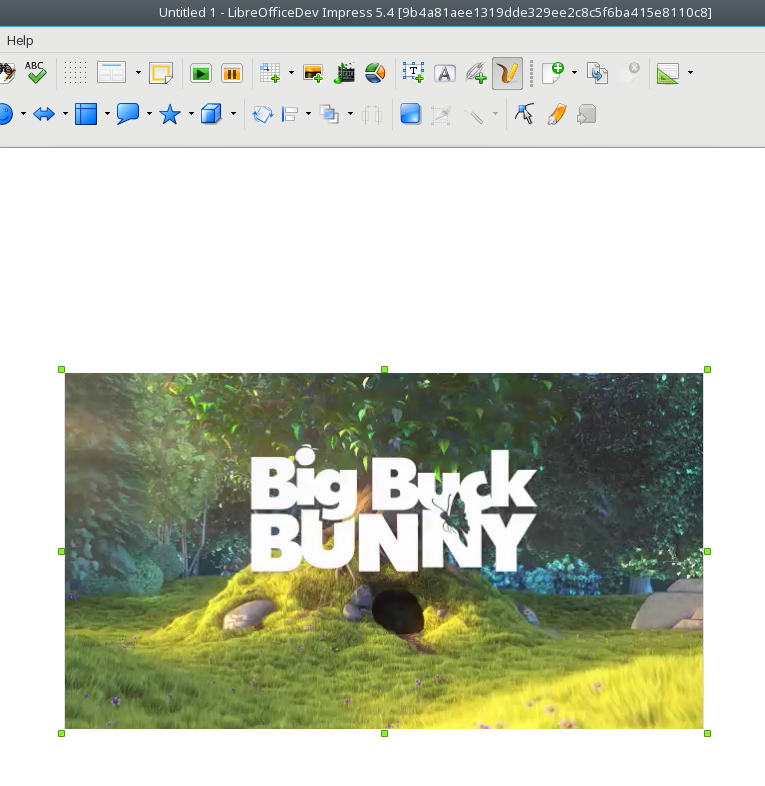
PDF supports screen annotations, which means it's possible to play embedded and linked videos on
top of a static image. Given that LibreOffice also supports videos, it made sense to add support for
this in our PDF export filter. First, thanks to PMG who made this work
possible. This is currently added for Writer and Impress.
Linked videos are the situation when the video is not part of the document itself, but it's located
somewhere else, e.g. a http:// location. This is helpful if you want to email around a PDF file, and
want to avoid sending large files when it has video content.
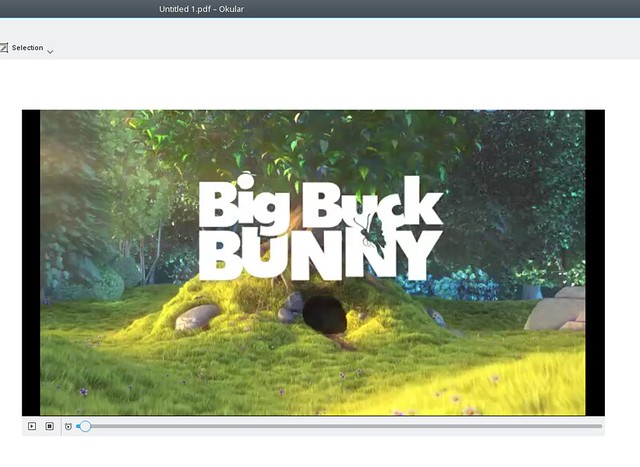
The result can be played using Adobe Acrobat Reader -- for some reason okular on Linux is a bit
confused about http:// URLs, wants to convert them to relative ones, and then fails as of today.
tdf#105093 is the embedded video case,
this is handy in case you want to create an entirely self-contained PDF, where even the video
content is inside the PDF file as an embedded file.
Regarding the situation around various video containers and codecs, the above code is quite agnostic.
:-) On the LibreOffice side all we require is to be able to extract a key frame from the video to
provide a preview image, so e.g. on Linux the support depends on what gstreamer plugins you have
installed. The video content is written to the PDF file as-is, so again if it will work in the PDF
reader is up to the reader's codec support. On Linux e.g. okular uses vlc for video playback, so the
range of supported formats is quite wide. The same is true on Windows, what I personally tested is
LibreOffice's VLC backend and the embedded QuickTime player in Acrobat Reader.
All of this is available on LibreOffice master towards 5.4.
FOSDEM 2017 is here this weekend, and as Michael Stahl pointed out,
this (together with the LibreOffice annual conference) are two time periods each year when lots of
Impress bugfixes are made, as people start dogfooding.
;-) So below you can read about a pair of Impress bugs I fixed recently.
Changing font size now takes table selection into account
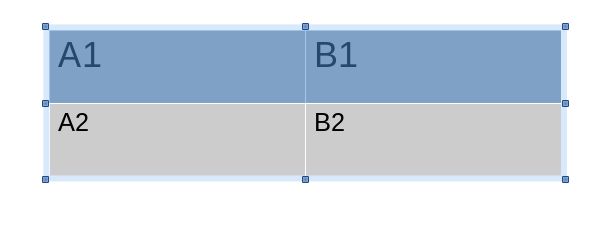
tdf#105502 is a situation where you
have an Impress table shape, and you select part of the cells, then you click on the sidebar to
change the font size. Previously this affected all cells of the table shape, now only the selected
cells are updated.
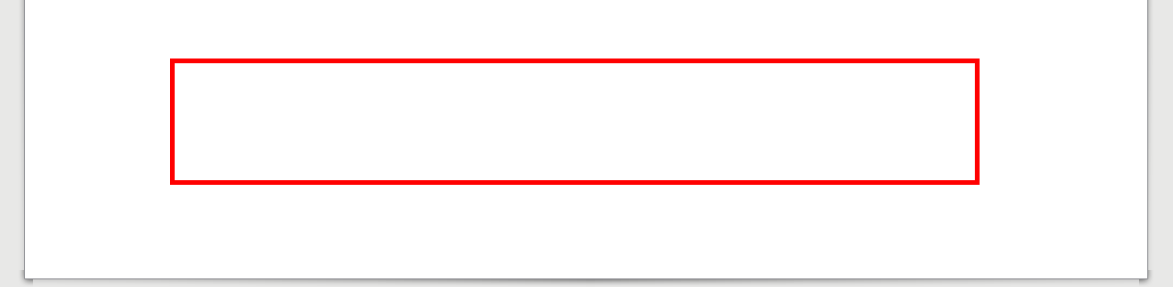
tdf#105150 is a PPT(X) filter bug where
a shape was previously imported as transparent, but it actually has to have the same fill type as
the slide background. In case of PPTX this was already handled in general, but not in case the slide
had no explicit background. The result was that in case the shape was used to cover other shapes,
they were visible, leading to e.g. this unexpected red rectangle on the screenshot.
The same bug was present in the PPT import, though there existing support was even more limited:
just the "background colored objects" were collected, but nothing was done to them. Now the above
use-case should be as good for PPT as it is for PPTX.
As mentioned in the blog post of Mike
already, last month we were allowed to hack on anything we want in LibreOffice for a few days. I used
this time to progress with 3 different topics.
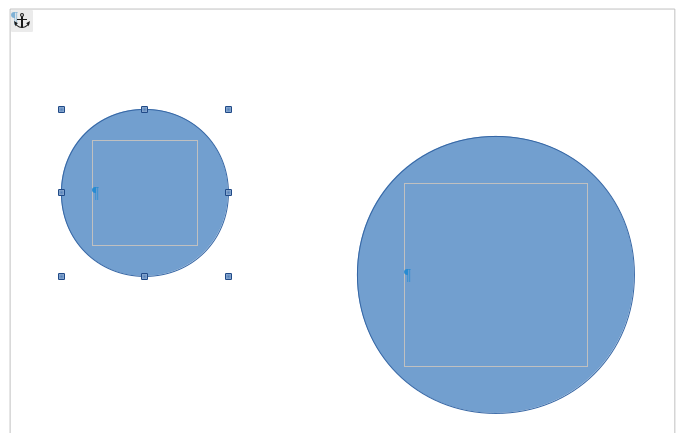
Given that a Writer shape with a TextBox is internally two shapes, this needed explicit support.
After my TextBox bugfix
it's possible to have two such shapes in a document, and once you select one of them, tab properly
jumps between the two shapes; previously nothing happened.
What did happen is we tried to activate the TextBox of the selected shape, which selected the shape
itself, so at the end nothing happened.
For some time it was already possible to import and export custom string document properties
from/to RTF, but just in case the value type of the property was string. Now I extended support for
these custom properties, so also the remaining types are handled:
numbers,
bools,
doubles
and
dates.
Last, I've started working on upstreaming external/libxmlsec/xmlsec1-noverify.patch.1. xmlsec has
no ability to disable the verification of certificates (think of curl -k or wget -k), so in
LibreOffice currently we just patch out that code as we don't need it. So I wanted to add a new
verification flag to avoid patching, but it turns out that in the NSS case xmlsec didn't do the
verification, so as a first step I fixed that instead in this xmlsec GitHub pull
request. Now that it's merged, the next step will be to
add such a flag, and then LibreOffice can get rid of the patch after the next xmlsec release.
Building on top of the previously mentioned
signing of existing PDF files work, one
more PDF feature coming in LibreOffice 5.3 is initial support for the PDF
Advanced Electronic Signatures (PAdES)
standard. First, thanks to the Dutch Ministry of Defense in cooperation with
Nou&Off who made this work possible.
PAdES is an extension of the ISO PDF signature with additional constraints, so
that it conforms to the requirements of the European eIDAS regulation, which
in turns makes it more likely that your signed PDF document will be actually
legally binding in many EU member states.
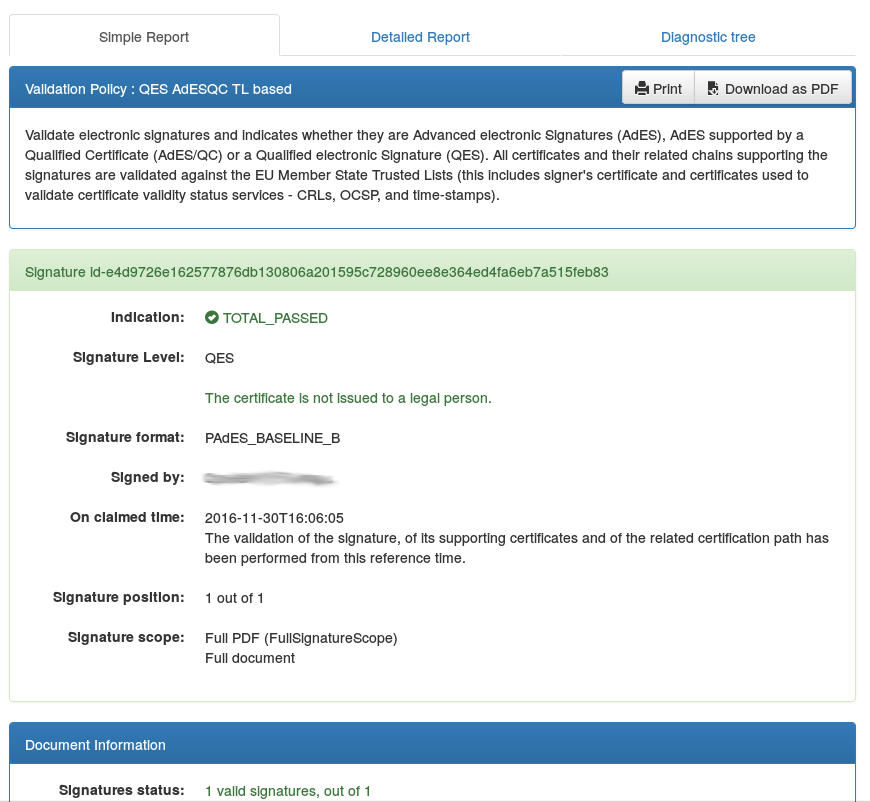
The best way to check if LibreOffice produces such PDF signatures is to use a
PAdES validator. So far I found two of them:
the ETSI one, which
requires registration and is a free web service
I implemented the followings in LO to make this happen:
PDF signature creation now defaults to the stronger SHA-256 (instead of the
previously used weaker SHA-1), and the PDF verifier understands SHA-256
the PDF signature creation now embeds the signing certificate into the
PKCS#7 signature blob in the PDF, so the verifier can check not only the key
used for the signing, but the actual certificate as well
the PDF signature import can now detect if such an embedded signing
certificate is present in the signature or not
NOTE: Don't get confused, LO does signature verification (checks if the digest
matches and validates the certificate) and now shows if the signing
certificate is present in the signature or not, but it doesn't do more than
that, the above mentioned DSS tool is still superior when it comes to do a
full validation of a PAdES signature.
As usual, this works both with NSS and MS CryptoAPI. In the previous post I
noted that one task was easier with CryptoAPI. Here I experienced the
opposite: when writing the signing certificate hash, I could provide templates
to NSS on how the ASN.1 encoding of it should happen, and NSS did the actual
ASN.1 DER encoding for me. In the CryptoAPI case there is no such API, so I
had to do this encoding manually (see
CreateSigningCertificateAttribute()),
which is obviously much more complicated.
Another pain was that the DSS tool doesn't really separate the validation of
the signature itself and of the certificate. The above screenshot was created
using a non-self-signed certificate, hence the unclear part in the signed-by
row.
If you want to try these out yourself, get a
daily build and feel free to play
with it. This work is part of both master or libreoffice-5-3, so those
builds are of interest. Happy testing! :-)
LibreOffice already made it possible to digitally sign PDF files as part of
the PDF export, so in case you had e.g. ODF documents and exported them to
PDF, optionally a single digital signature could be added as part of the
export process. This is now much improved. First, thanks to the Dutch Ministry
of Defense in cooperation with Nou&Off who made this work
possible.
A user can already use an other application to verify that signature or sign
an already existing PDF file. The idea is to allow doing these from inside
LibreOffice, directly.
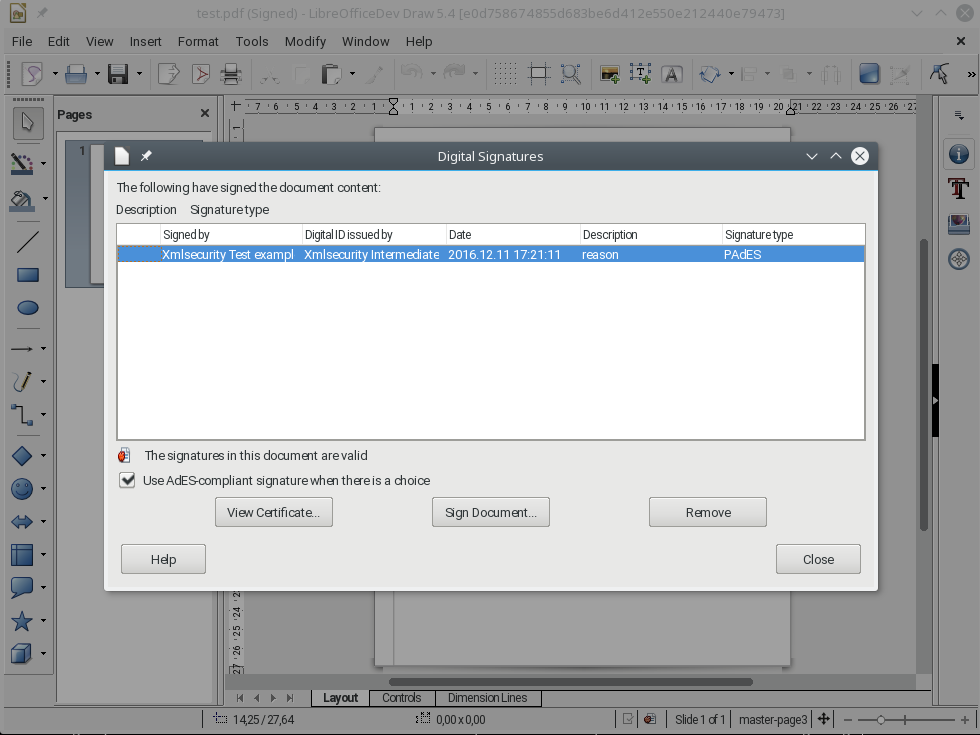
As it can be seen above, now the Digital Signatures dialog not only works for
ODF and OOXML files, but also for PDF files. If the file has been signed, then
the dialog performs verifications of that signature. Signatures are also
verified on opening any signed PDF file.
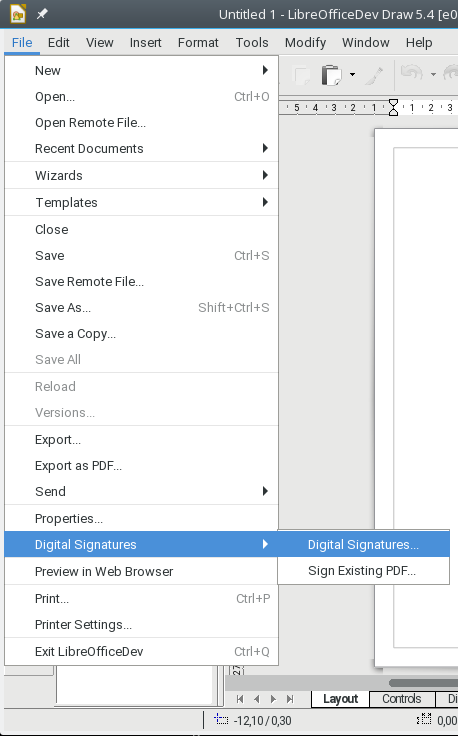
I've also extended the user interface a bit, so that signing an existing PDF
file is easy, similarly how exporting to PDF is easier than exporting to a
random other file format. There is now a new File -> Digital signatures ->
Sign exiting PDF menu item to open a PDF file for signing:
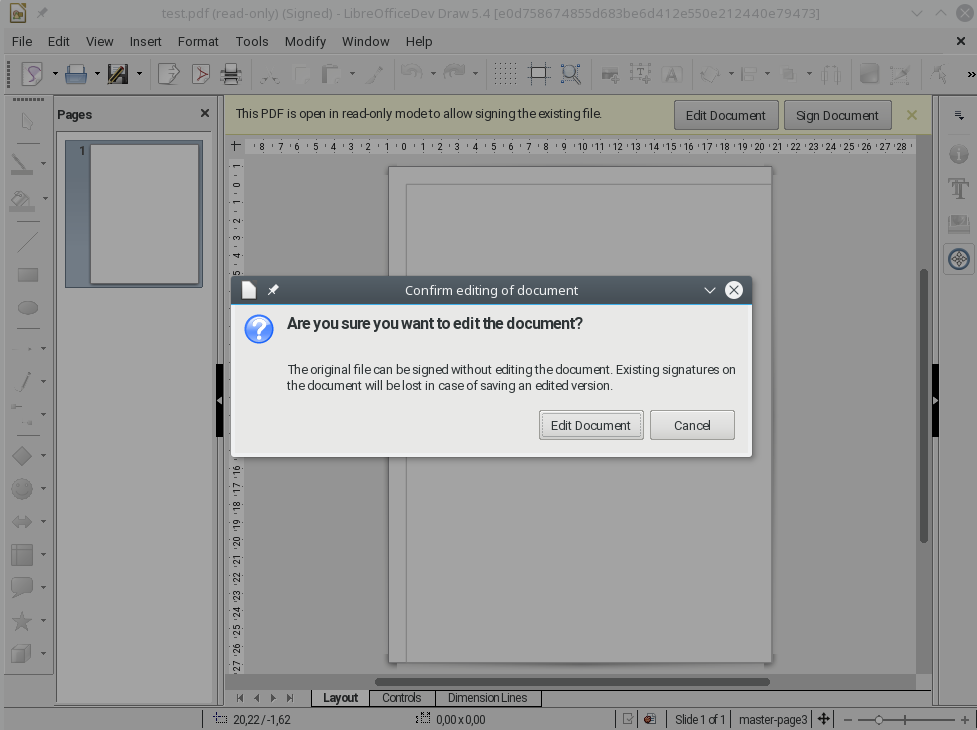
When that happens the infobar has a dedicated button to open the Digital
Signatures dialog, and also going into editing mode triggers a warning dialog,
as going read-write is not needed to be able to sign a document:
And that's basically it, after you open a PDF file in Draw, you can do the
usual digital signature operations on the file, just like it already works for
previously supported file formats.
What follows is something you can probably skip if you're a user -- however if
you're a developer and you want to understand how the above is implemented,
then read on. ;-)
The signing feature in ODF/OOXML is implemented by working directly on the ZIP
storage in xmlsecurity/. This means that in the PDF case it's necessary to
work on the PDF file directly, except that we had no such PDF tokenizer
ready to be used.
Code under xmlsecurity/source/pdfio/ now is such a tokenizer that can
extract info from PDF files and can also add incremental updates at the end of
the file, this way we can make sure adding a signature to a file won't loose
existing content in the file. This is fundamentally different form the usual
load-edit-save workflow, when we convert the file into a document model, and
work on that.
Previously LO was only able to generate signatures, not verify them. I've
implemented PDF signature verification using both NSS and CryptoAPI, so all
Windows, Linux and macOS are covered. I have to admit that the initial verification
was much easier with CryptoAPI. Until I hit corner-cases, I could use an API
that's well-documented and is higher level than NSS. (I don't have to support
different hash types explicitly, for example.)
When I added support for non-detached signatures, that changed the situation a bit:
Signing an existing file means tokenizing a document, figuring out how an
incremental update should look like for that file, writing an incremental
update that has a placeholder for the actual signature (a PKCS#7 blob, where
the input is just the non-placeholder parts of the document as binary data), and
finally filling in the placeholder with the actual signature.
For the last step, I could reuse code from the PDF export (modulo fixing bugs
like tdf#99327).
For the other steps, the tokenizer remembers the input offset / length for the
given token, this way it's relatively easy to create incremental updates. You
can add new objects or update new objects in such an incremental update, and
this source tracking feature allows copying even the unchanged parts of
updated objects verbatim.
Everything becomes a bit more complicated once I started to handle not only
LO-generated PDF-1.4, but also newer PDF versions. I think this is important,
as Adobe Acrobat creates PDF 1.6 by default today, which has a number of new
features (I think all of them were actually introduced in PDF-1.5) that
affects the tokenizer:
xref stream: instead of an ASCII xref table ("table of contents") at the end
of the file, it's now possible to write the binary equivalent of this as an
xref stream. Because the binary version can describe more features we must
also write an updated xref stream (and not an xref table) when the import
already had an xref stream.
object streams: it's now possible to write multiple objects inside the
stream section of a single object in binary form. The tokenizer is necessary
to be able to read these objects and also roundtripping (source tracking)
should work not only with physical file offsets, but also inside such
compressed streams where the offset is no longer just a number inside the
input file. (It's OK to write the updated objects outside object streams,
still.)
stream predictors: this is a concept from the PNG format, but also used in
PDF when compressing the xref stream. See the spec for the gory details, but
in short it's not enough that instead of plaintext you have to deal with
binary compressed data, you also have to filter the data before actually
parsing the file offsets, and the filter is defined not in terms of object IDs
and file offsets, but in terms of adjacent pixels, since it's documented in
the PNG spec. :-) (To be close to the Adobe output, we also apply such
predictors when writing compressed xref streams.)
In addition to be UI changes already mentioned above, one more improvement I
did is that now the Digital Signatures dialog has a new column to show the
signature type. This is either XML-DSig (for ODF/OOXML) or PDF.
I've added an integration test in the existing
CppunitTest_xmlsecurity_signing to have coverage for the small new code that
calls into xmlsecurity/ from sfx2/ in case of PDF files. But fortunately
because all other code in xmlsecurity/ was new, I could do unit testing in
CppunitTest_xmlsecurity_pdfsigning for the rest of the features.
Needless to say that invoking the PDF tokenizer + signature creator/verifier
directly is much quicker than loading a full PDF file into Draw, just to see
the signature status. ;-)
If you want to try these out yourself, get a
daily build and play with it! This
work is part of both master or libreoffice-5-3, so those builds are of
interest. Happy testing! :-)
LibreOffice 5.3 will add one more vector-based format that can be inserted as
an image into documents: PDF. First, thanks to PMG who made
this work possible. On the user interface you can now select PDF files when
you choose e.g. Writer's Insert -> Image option:
The first page of the PDF document will be shown, which is handy if the PDF
file is basically used as a vector image format.
Similarly to the SVG feature, the original vector image is stored in the
document, but when saving to ODF, a replacement PNG file is also generated to
be backwards compatible with older ODF readers. The image context menu -> Save
menu item allows to extract your original PDF data from the image, too:
And that's it, as long as you save your document in ODF, your PDF-as-an-image
will be kept without loosing any data. As usual, you can try this right now
with a 5.3 daily build. :-)
However, if you're interested in how this is implemented, keep reading...
The PDF image in the document model is really similar to how SVG is handled,
next to Graphic::getSvgData(), there is now a Graphic::getPdfData().
This new member function exposes the original PDF data, otherwise the Graphic
is just a metafile.
The ReplacementGraphicURL property of the image at an UNO level now exposes
the generated metafile for PDF images. This is implemented for both Draw and
Writer images, and is used by the ODF export filter.
When the Graphic instance is rendered, the layout knows nothing about the
PDF data attached to the object, only parses the generated metafile. This way
the display of the PDF image works out of the box.
First I've implemented a
PDF
import-as-graphic filter, then the
export
equivalent of it. As you can see, the PDF import-as-graphic filter isn't too
complicated, it completely reuses the existing "import PDF into Draw" filter,
it simply copies the first page of the resulting document model as a metafile.
Second, once the graphic filters were working, I've also
improved
the ODF import to recognize PDF data -- the export side needed no explicit
work, once the ReplacementGraphicURL bits were in place.
As mentioned above, the Draw and the Writer image implementation is separate,
so first I've added tests for ODT files in the testEmbeddedPdf of
CppunitTest_sw_odfexport, and then SdExportTest::testEmbeddedPdf() to
cover ODP files (and other ODF formats). Second, the PDF part of the graphic
swapout/in code has a dedicated test in GraphicObjectTest::testPdf(), and
the UI's "Save original PDF" feature has a new
XOutdevTest::testPdfGraphicExport() test.
Oh, and if you intent to test this manually in a self-created build, make sure
to avoid --disable-pdfimport, otherwise this feature can't work. ;-)
It was requested to
be able to set the small capitals character property via a toolbar button in
Writer, which was indeed not possible. Not only the toolbar button wasn't
there, but the underlying UNO command was also missing (which you can use e.g.
from a macro to format the current selection).
So my
commit
added a simple set of icons to the galaxy theme for the new toolbar button,
defined the new UNO command for Writer text and added it to Writer's text
object bar, next to the upper case and lower case buttons (hidden by default).
One difference from those buttons is that those buttons perform a
transliteration, while this one really just sets a character property, you can
easily undo the property later if needed.
Wrt. other icon themes, see
this mail,
hopefully the design team can help there.
As usual, you can try this right now with a 5.3
daily build. :-)
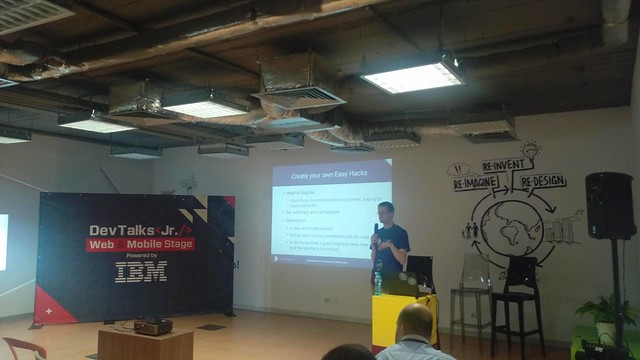
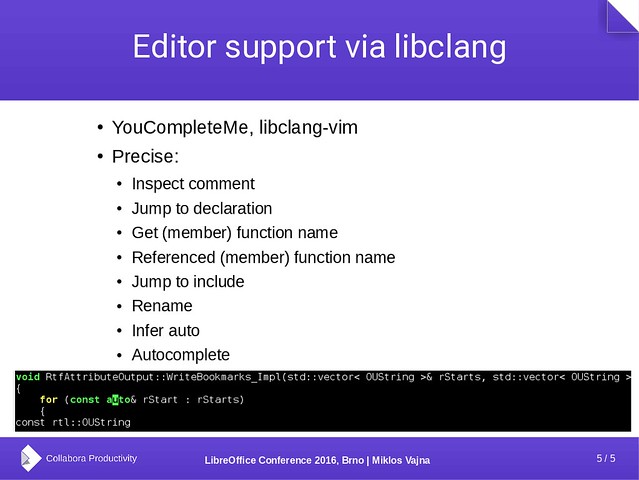
The last week I gave a
Using
clang-based tools beyond loplugin lightning talk at LibreOffice conference
2016, on the last day. Click on the image to see all the slides.
If you're a vim or emacs user and you work with C++11 code, you probably
want to have a look at
clang-rename,
include-fixer and some editor
plugin exposing the power of libclang (like
YouCompleteMe or
libclang-vim), sometimes these
are really helpful.
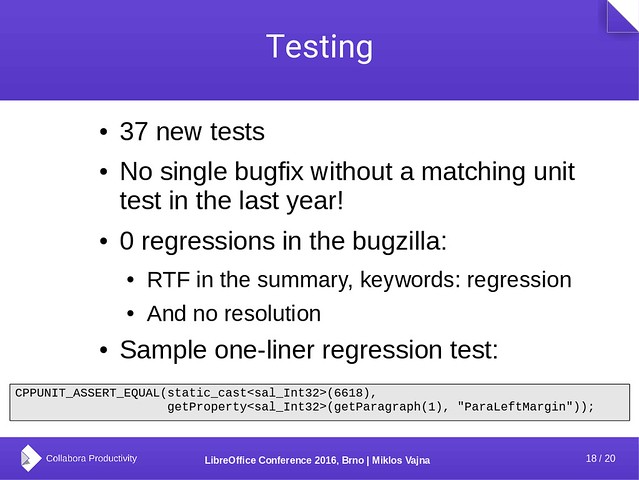
Last week I gave a
year in
LibreOffice's RTF support talk at LibreOffice conference 2016, in the
development track. Click on the image to see all the slides.
I've also published a number of (mostly)
sightseeing
pictures based on wondering around in Brno before and after the conference.